


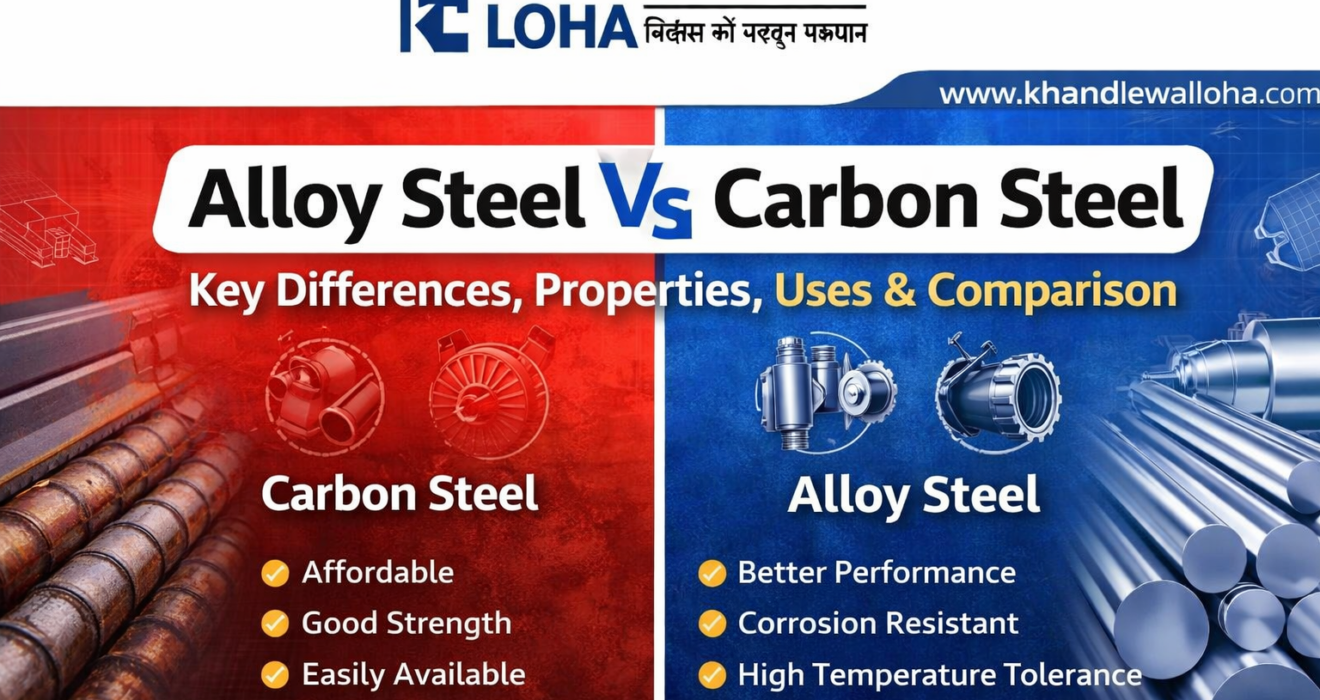
Alloy Steel Vs Carbon Steel: Key Differences, Properties, Uses & Comparison
Alloy Steel Vs Carbon Steel: Key Differences, Properties, Uses & Comparison– Steel is one of the most important materials used in the modern world. It is used in construction, automobiles, machinery, tools, pipelines, and many other industries. Steel is mainly made by mixing iron and carbon. By changing the amount of carbon and adding other elements, different types of steel are produced with different properties.
Among the many types of steel available, carbon steel and alloy steel are two of the most commonly used. While both are strong and durable, they differ in composition, performance, cost, and applications. Khandelwal Loha presents an overview explaining Alloy Steel vs Carbon Steel: Key Differences, Properties, Uses & Comparison. Helping consumers make an informed and positive choice while selecting Alloy Steel or Carbon Steel.
Define Carbon Steels and their Properties: Explanation
While talking about carbon steel, it is a steel that mainly contains iron and carbon alloy, the amount of carbon being about 2%. Along with this, a minimum amount of manganese, silicon, sulfur, and phosphorus is also present. Carbon steel does not contain significant amounts of other alloying elements. The strength and hardness of the steel are determined by the percentage of carbon present in it.
Carbon steels are divided into three types, which have been mentioned as follows:
Low Carbon Steel
Low Carbon Steel – it contains a small amount of carbon (up to 0.3%). It is soft, flexible, and easy to shape and weld. It is widely used in general construction work.
Medium Carbon Steel
Medium Carbon Steel – it contains 0.3% to 0.6% carbon. It offers a balance between strength and flexibility. It is commonly used in automotive parts and machinery components.
High Carbon Steel
High Carbon Steel– it contains more than 0.6% carbon. It is very hard and strong but less flexible. Also, it is used for cutting tools, springs, and high-strength wires.
Carbon steel is popular because it is affordable and easily available.
What are Alloy Steels?
Alloy steel is made by adding extra elements to iron and carbon. These elements may include chromium, nickel, molybdenum, vanadium, or manganese. These added materials improve certain properties of steel.
The purpose of adding alloying elements is to increase:
- Strength
- Toughness
- Corrosion resistance
- Heat resistance
Alloy steel can be classified as low alloy or high alloy, depending on the amount of these elements added. It is specially designed for applications that require better performance and durability.
What are the Key Differences Between Alloy Steel and Carbon Steel?
Carbon steel and Alloy Steel differ in various factors, such as composition, affordability, properties, uses, and much more. Understanding these differences between these two types of steel helps in choosing the right material. Here’s detailed information on Carbon steels and Alloy Steel, considered as follows:
Composition
The main difference lies in what they are made of.
- Carbon steel mainly contains iron and carbon, along with small amounts of other elements. Only 2% of carbon is used while forming the Carbon Steels.
- Alloy steel contains iron, carbon, and additional elements like chromium, nickel, or molybdenum.
Because of these added elements, alloy steel can offer improved properties compared to carbon steel.
Strength and Toughness
In carbon steel, strength increases as the carbon content increases. However, higher carbon also makes the steel more brittle and less flexible.
In alloy steel, strength and toughness are improved by alloying elements. These elements allow the steel to remain strong without becoming too brittle.
As a result, Alloy steel can handle heavy loads and high stress more effectively.
Corrosion Resistance
Carbon steel is more likely to rust when exposed to moisture and air. It usually needs protective coatings like paint or galvanizing, especially during rainy seasons.
Alloy steel, especially when chromium is added, has better corrosion resistance. This makes it more suitable for outdoor or harsh environments.
Heat Resistance
Carbon steel may lose strength when exposed to high temperatures for a long time.
Alloy steel performs better in high-temperature conditions due to added elements that improve heat resistance. This makes alloy steel suitable for boilers, engines, and industrial equipment.
Cost-Effectiveness
Carbon steel is generally more affordable, as it has a simpler composition and manufacturing process.
Alloy steel is more expensive due to added elements and unique processing.
However, the higher cost is approved by its better performance and longer service life.
Properties of Carbon Steel
Carbon steel is ideal for applications where high corrosion resistance is not required.
- Good strength, especially in medium- and high-carbon types
- High hardness in high-carbon steel
- Easy to cut, weld, and shape
- Lower resistance to rust
- Cost-effective for general use
Properties of Alloy Steel
Alloy steel is structured for performance in tough and extreme environments. The properties of Alloy Steels are mentioned below as follows:
- Higher strength and toughness
- Better corrosion resistance
- Improved heat resistance
- Longer durability in harsh conditions
Uses of Carbon Steel
Carbon steel emerges as a cost-effective solution, required for various purposes, some of which have been mentioned below as follows:
- It is used while building structures such as beams and rods.
- Alloy steels are used extensively in bridges and general construction.
- Pipes and tubes, along with forming knives and cutting blades
- Machinery parts, including gear shafts, industry-need machines
Uses of Alloy Steel
Alloy steels are used in various industries, offering various benefits, mainly in applications that require strength, resistance to heat, corrosion, and durability. A list of uses has been mentioned as follows:
- Automotive parts such as gears and shafts
- Power plants and pressure vessels
- Oil and gas industry equipment
- Aircraft components and high-strength tools
Alloy Steel or Carbon Steel: What’s Right for You?
Choosing between alloy steel and carbon steel mainly depends on your project requirements and structure. If your project requires a cost-effective material for general construction or basic structural use, carbon steel is a practical and cost-effective choice, as it provides good strength and is easy to work with.
However, if your application involves heavy loads, high temperatures, exposure to moisture, or harsh environments, alloy steel is a better choice. Although it is more expensive, it offers better performance, durability, and a longer service life.
Conclusion
Both carbon steel and alloy steel have their own advantages and applications. Carbon steel is simple, strong, and affordable, making it suitable for general-purpose use. Alloy steel offers enhanced strength, better resistance to heat and corrosion, and improved durability for demanding applications. Understanding these differences helps in selecting the right material for safe and efficient usage.