


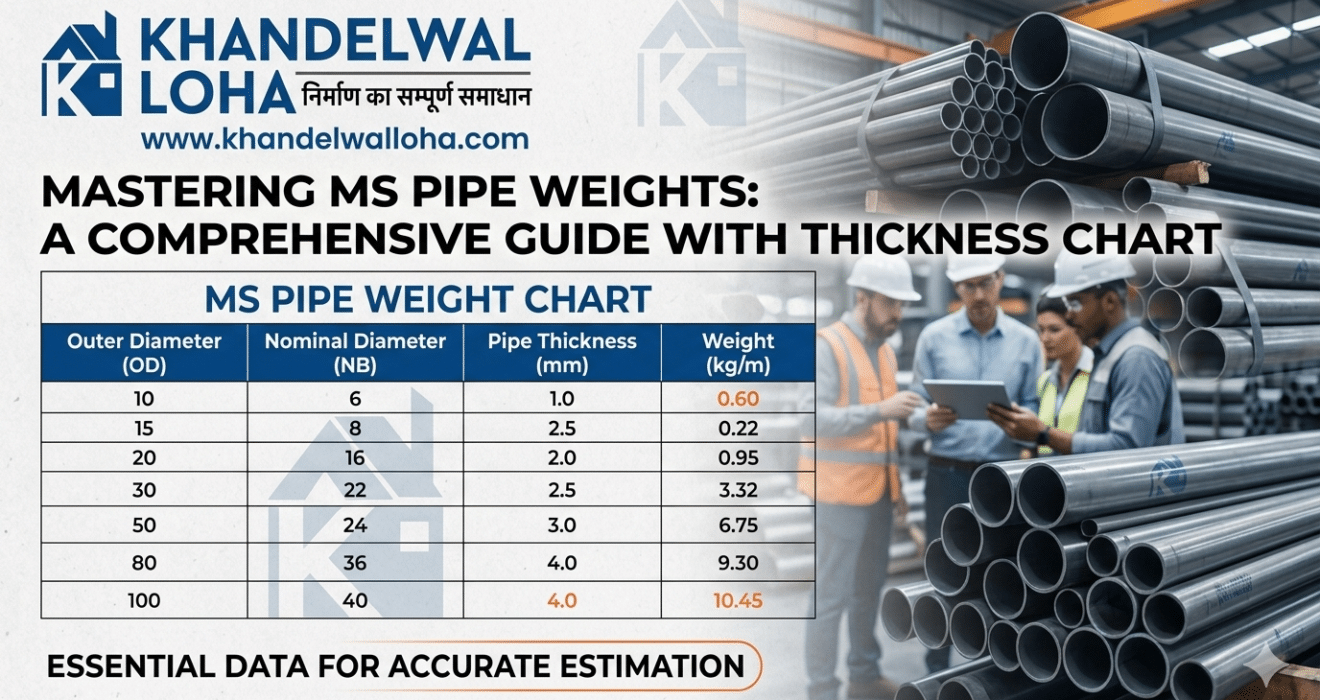
MS Pipe Weight Chart With Thickness
MS Pipe Weight Chart With Thickness – MS Pipe, Mild Steel pipe is also known as low-carbon steel pipe. These are used extensively in fields like construction, plumbing, industrial applications, and fabrication for various purposes. They are recognized as cost-effective, durable, and strength-efficient.
The MS pipes are made from low-carbon steel and can be welded, formed, and applied easily. As a result, they are the most popular choice among engineers and contractors. A weight chart for MS pipes of a particular thickness will be a reference for every user, which helps to determine the weight of an MS pipe of a particular diameter and thickness.
As a result, the significance of the MS pipe of a specific thickness supports defining the pipe’s diameter, thickness, and weight. Certain MS pipe thicknesses determine the strength of a pipe and for which they are applied.
In order to prevent material waste and ensure proper pipe application, MS pipe thickness charts and weights are needed. MS pipe’s outstanding qualities of adaptability and long-term efficiency guarantee dependability. Therefore, an MS pipe weight chart with thickness eliminates the need for manual calculations by offering ready reference values. Khandelwal Loha presents detailed information to help people gain maximum information, which helps them make informed choices.
What is an MS Pipe?
Mild steel pipes are made from low-carbon steels; these are hollow-cylindrical tubes.
These are commonly used in industries and construction, as well as in plumbing applications. MS pipes generally consist of about 98-99% iron, and 0.05-0.25% is carbon. Along with it, there are traces of elements such as manganese, silicon, sulfur, and phosphorus. It is mostly used in construction applications, water distribution systems, and also in fabrication and gas pipes.
Different and Common Types of MS Pipes
MS pipes are of different types; each one of them is separate due to their properties, compositions, diameter, and Applications. Different types of MS pipes used for plumbing applications are black MS pipes, galvanized pipes, ERW pipes, and seamless MS pipes.
There is no major difference in the composition, but there are slight differences between coating and welding in these pipes. They are easy to weld and sturdy, malleable, and economical
A list of common types of MS pipes is listed below as follows:
Seamless MS Pipes: These are solid mild steel billets that are heated and formed without any welding joints.
Uses: Used in boilers and gas industries.
Black MS Pipes: These MS pipes are made of uncoated mild steel, are not galvanized, and have no protective layer.
Uses: gas lines, industrial applications, etc.
Welded MS Pipes: ERW (Electrical Resistance Welded) pipes are made by rolling steel sheets. These are highly cost-effective.
Uses: These pipes are used in water piping and fencing.
Galvanized Pipes: These MS Pipes are protected by applying a layer of zinc, protecting them from rusting.
Uses: These are used for plumbing and outdoor applications.
How to calculate the MS pipe weight with thickness?
Here’s how to calculate the Weight of a Mild Steel (MS Pipe) with thickness.
The formula is mentioned below:
W = 4π × (D² − d²) × L × ρ
OR,
Weight (kg) = [(OD − Thickness) × Thickness × 0.02466] × Length
Where,
OD = Outer Diameter (mm)
t = Wall Thickness (mm)
d = Inner Diameter = OD − (2 × t)
L = Length (m)
ρ = Density of MS = 7.85 g/cm³ (or 7850 kg/m³)
0.02466 = simplified constant (derived from π/4 × 7.85/1000)
MS Pipe Weight Chart With Thickness
Class A – Light Duty
| NB Size | OD (mm) | Thickness (mm) | Weight (kg/m) |
|---|---|---|---|
| 15 NB (½”) | 21.3 | 2.0 | 0.98 |
| 20 NB (¾”) | 26.9 | 2.3 | 1.36 |
| 25 NB (1”) | 33.7 | 2.6 | 1.88 |
| 40 NB (1½”) | 48.3 | 2.9 | 3.00 |
| 50 NB (2”) | 60.3 | 3.2 | 4.20 |
| 65 NB | 76.1 | 3.2 | 5.60 |
| 80 NB | 88.9 | 3.2 | 6.60 |
| 100 NB | 114.3 | 4.0 | 9.80 |
Class B – Medium Duty
| NB Size | OD (mm) | Thickness (mm) | Weight (kg/m) |
|---|---|---|---|
| 15 NB | 21.3 | 2.6 | 1.26 |
| 20 NB | 26.9 | 2.9 | 1.73 |
| 25 NB | 33.7 | 3.2 | 2.35 |
| 40 NB | 48.3 | 3.2 | 3.58 |
| 50 NB | 60.3 | 3.6 | 4.83 |
| 65 NB | 76.1 | 3.6 | 6.10 |
| 80 NB | 88.9 | 4.0 | 8.00 |
| 100 NB | 114.3 | 4.5 | 11.25 |
Class C – Heavy Duty
| NB Size | OD (mm) | Thickness (mm) | Weight (kg/m) |
|---|---|---|---|
| 15 NB | 21.3 | 3.2 | 1.27 |
| 20 NB | 26.9 | 3.2 | 1.68 |
| 25 NB | 33.7 | 3.6 | 2.41 |
| 40 NB | 48.3 | 3.8 | 3.81 |
| 50 NB | 60.3 | 4.5 | 5.44 |
| 100 NB | 114.3 | 5.4 | 12.64 |
| 150 NB | 168.3 | 5.4 | 19.64 |
Discover the Importance of MS Pipes: Explanation
MS Pipes offers various key benefits and importance in the industrial and construction landscape. These are described as follows:
Structural integrity
MS pipes have high load capacities, hence forming the foundation of the construction industry. MS pipes play an important role in framework construction, scaffolding, and offering structural support.
Wide Applications
These include industries such as plumbing, agriculture, and fabrication industries, as well as infrastructural development.
Cost-effective Solutions
MS pipes are less expensive to purchase than other metals, which contributes to lower long-term construction costs.
Easy to fabricate
Containing low carbon content, they can be easily cut, bent, and welded.
Durability with treatment
Corrosion resistance is improved when MS pipes are coated or galvanized, extending the life of pipe segments.
Conclusion
To save time on project planning in construction or industrial settings, a precise MS pipe weight chart with dimensions and thickness should be readily available. Accurate weight calculations save time while also ensuring the structure’s strength and security. Having information such as pipe size, thickness grades, and calculation formulae aids in the accurate specification of any project. Khandelwal Loha provides high-quality, well-manufactured, and strong MS pipes.